 .pdf
.pdf
Overview of Exa-MA
Exa-MA is a flagship project of the French NumPEx initiative, developing cutting-edge methods, algorithms, and software to unlock the full potential of exascale computing for scientific discovery.
1. Grand Challenges We Address
Extreme-scale computing enables solutions to problems where experiments are impossible, hazardous, or prohibitively expensive. Exa-MA contributes to solving humanity’s most pressing scientific challenges:
Climate & Environment
Reduce carbon footprint in transportation, buildings, and cities; monitor planetary health
Energy & Materials
Design advanced materials, renewable energy resources, and fusion reactor facilities
Health & Life Sciences
Understand the human brain, personalize healthcare, and design better drugs
Universe & Discovery
Understand fundamental physics and explore the cosmos through simulation
Manufacturing
Design, control, and manufacture next-generation products and systems
Decision Support
Empower decision-makers with unprecedented predictive capabilities
2. Exascale Bottlenecks
As we push toward exascale computing, new challenges emerge. Exa-MA directly addresses the algorithmic and methodological bottlenecks (B7-B11, B13):
Hardware & System Challenges
(Addressed through transverse NumPEx collaborations)
-
B1 Energy efficiency – Meet the 20 MW target
-
B2 Interconnect – Improve data movement efficiency
-
B3 Memory – Integrate new memory technologies
-
B4 System software – Increase scalability and resilience
-
B5 Programming – New paradigms for concurrency
-
B6 Data management – Handle massive I/O efficiently
Algorithms & Methods Challenges
(Directly addressed by Exa-MA)
-
B7 Exascale algorithms – Reduce communication, avoid synchronization
-
B8 Discovery algorithms – Ensemble runs for UQ and optimization
-
B9 Resilience & accuracy – Correct, reproducible, verifiable results
-
B10 Productivity – Tools for productive use of exascale systems
-
B11 Reproducibility – Trust through reproducible computation
-
B13 Uncertainty – Integrate UQ into computation core
3. Our Objectives
O1: Advanced Methods
Develop methods, algorithms, and implementations that empower modeling, solving, data assimilation, optimization, and uncertainty quantification at unprecedented scales
O2: Software Libraries
Develop reusable software components that hide hardware complexity while exposing clean methodological interfaces
O3: Algorithmic Patterns
Identify and co-design methodological and algorithmic patterns reusable across large-scale applications
O4: AI at Exascale
Enable AI algorithms to achieve exascale performance, leveraging our methods and libraries
O5: Demonstrators
Provide mini-apps and proxy-apps that are openly available and benchmarked
4. Work Packages
Exa-MA is organized into seven scientific work packages plus project management, designed to address both immediate challenges and pave the way for future advances.
Numerical Methods Foundation
Mesh generation, adaptive refinement, finite element frameworks, parallel-in-time, multiphysics coupling
Physics-driven deep learning, neural operators, reduced order models, multi-fidelity modeling
Domain decomposition, mixed precision, data sparsity, adaptive strategies, multiphysics coupling
Data & Decision Making
Data assimilation, deterministic/stochastic methods, observation strategies, model updates
Exact/approximate algorithms, surrogate-based, shape optimization, AutoML at exascale
Sensitivity analysis, surrogate modeling, acceleration on exascale, high-dimensional integrals
Integration & Coordination
Testing, CI/CD, verification/validation, co-design coordination, training materials
Coordination, scientific/technical oversight, resources, communication, reporting
5. Inter-WP Collaboration
The work packages are designed with natural collaboration pathways:
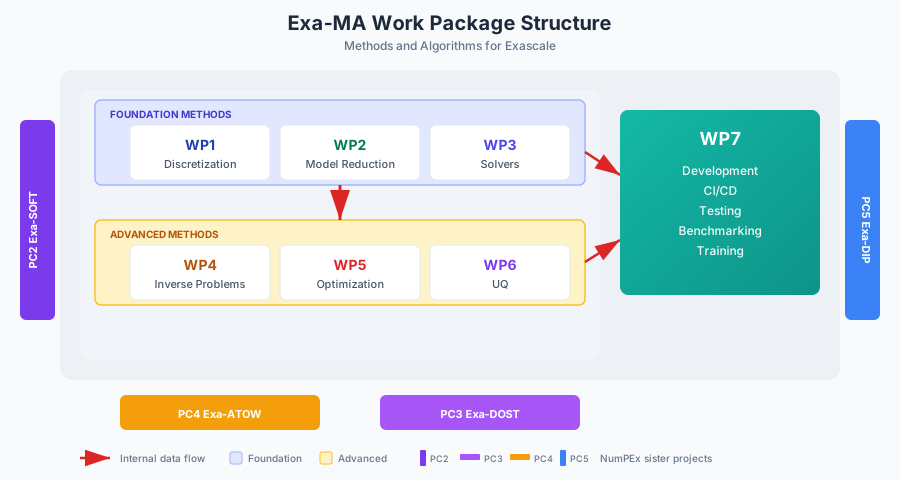
Foundation Methods (WP1, WP2, WP3)
-
WP1 provides space-time discretization, mesh generation, and coupling strategies
-
WP2 develops surrogate models and scientific machine learning methods
-
WP3 delivers scalable solvers and linear algebra capabilities
Advanced Methods (WP4, WP5, WP6)
-
WP4 combines foundation methods for inverse problems and data assimilation
-
WP5 leverages surrogates and solvers for optimization at scale
-
WP6 integrates uncertainty quantification across all methods
Integration Hub (WP7)
WP7 provides the development infrastructure, CI/CD pipelines, testing frameworks, benchmarking environments, and training materials that enable all work packages to deliver production-ready software.
NumPEx Ecosystem
Exa-MA collaborates with sister projects: PC2 Exa-SOFT (software stack), PC3 Exa-DOST (data-oriented software), PC4 Exa-ATOW (applications), and PC5 Exa-DIP (demonstrators and integration).
6. Future Perspectives
Exa-MA is not only addressing immediate exascale challenges but strategically positioning for the future:
Zettascale Computing
Algorithms and methods scalable to the next frontier of computing power
Quantum Integration
Insights for future hybrid classical-quantum computing systems
AI-HPC Convergence
Deep integration of AI methods with scientific computing workflows
Resilience at Scale
Error handling and fault tolerance for systems with millions of components